 AI for Computational Materials Science
🌟 Overview
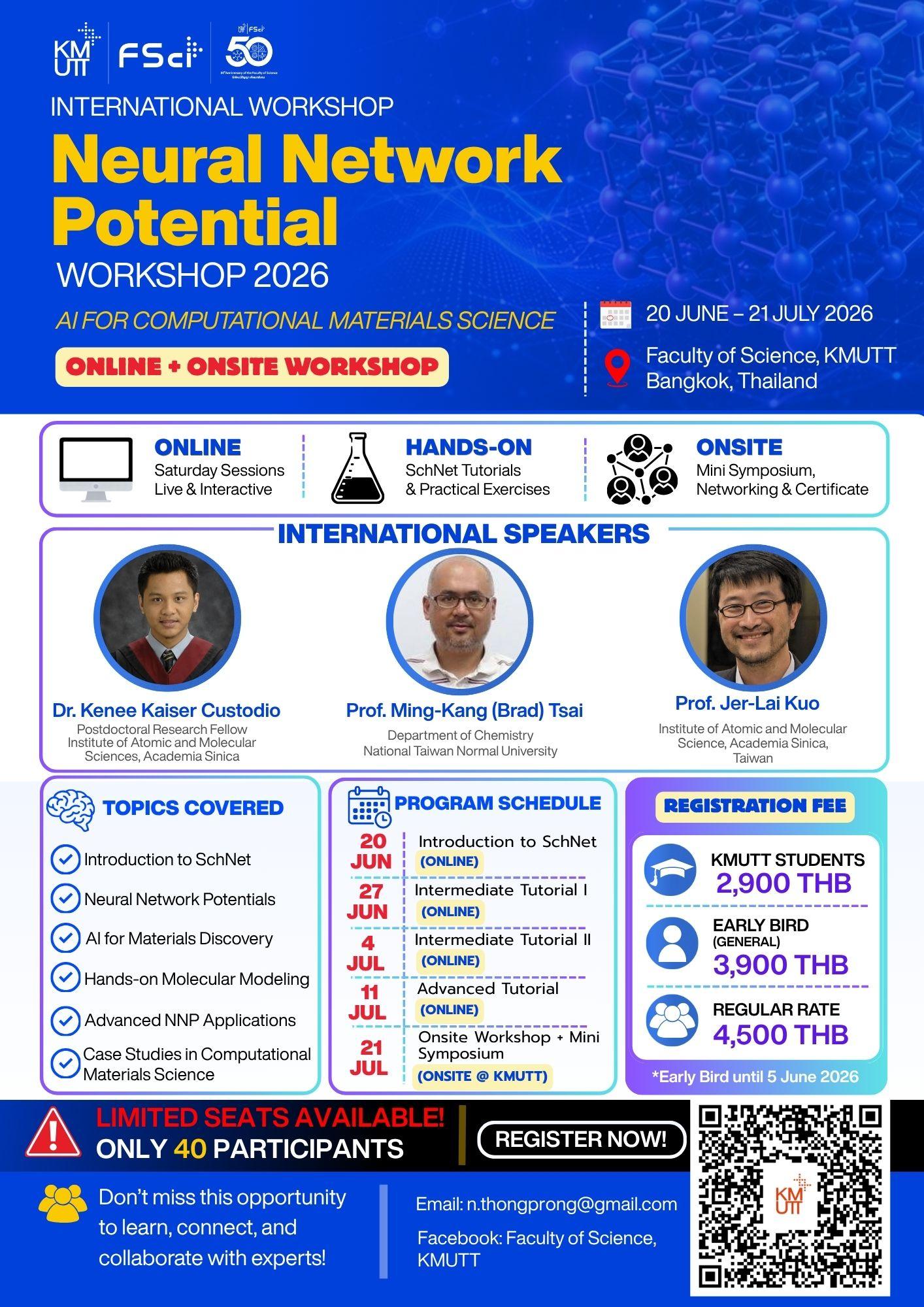
The Faculty of Science, King Mongkut’s University of Technology Thonburi (KMUTT), is pleased to announce the Neural Network Potential Workshop 2026, an intensive hybrid training program designed to introduce researchers and students to modern machine-learning approaches for molecular modeling and computational materials science.
Neural Network Potentials (NNPs) have emerged as one of the most powerful tools for bridging the gap between quantum chemical accuracy and large-scale molecular simulations. By leveraging deep learning techniques, NNPs enable efficient exploration of complex molecular systems while maintaining near first-principles accuracy.
This workshop will provide participants with both theoretical foundations and practical experience using SchNet-based workflows for molecular structure search, active learning, dataset preparation, model training, structural analysis, and applications to computational chemistry and materials science research.
—
🌟 International Speakers
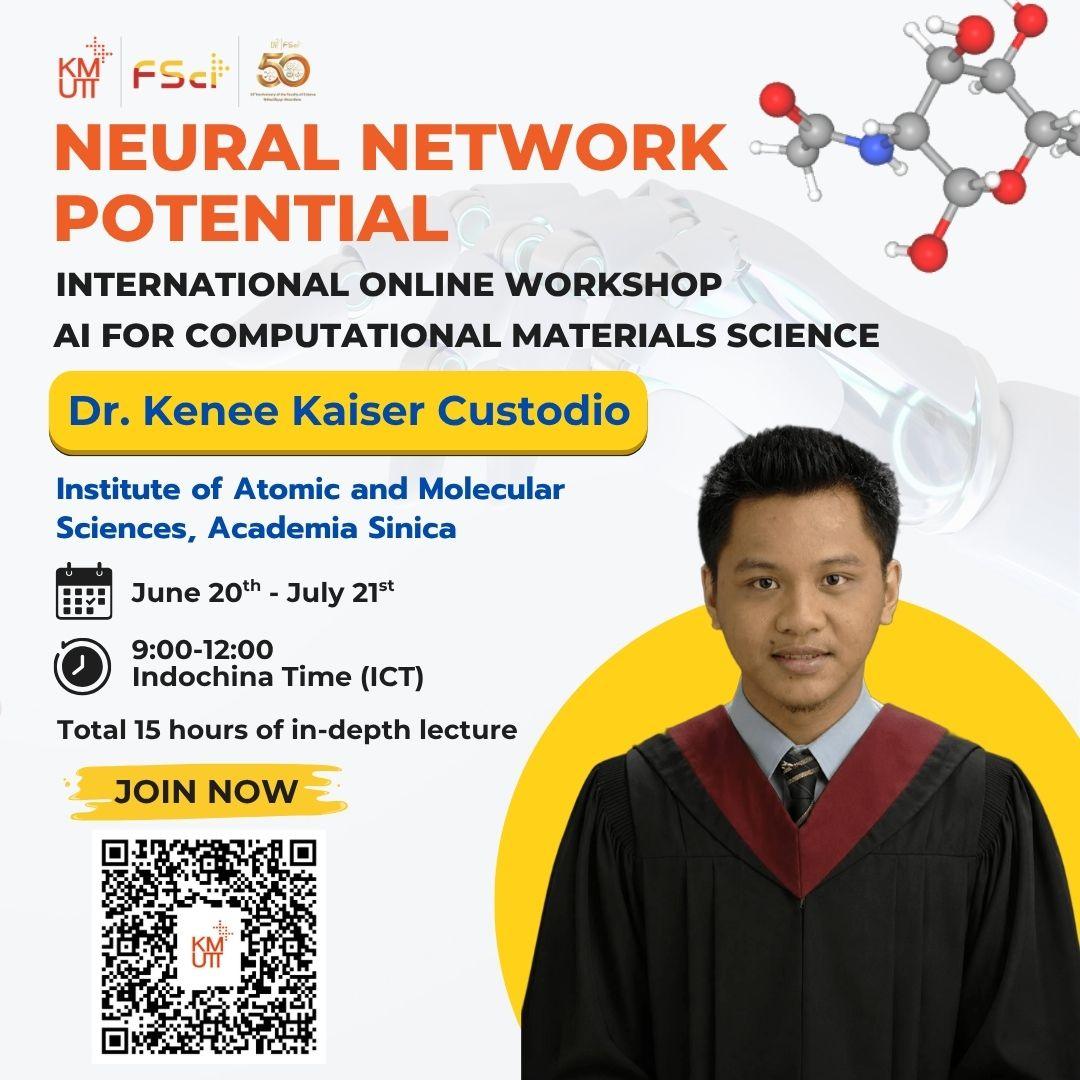
🌟 Dr. Kenee Kaiser Custodio
🌟 Prof. Jer-Lai Kuo
Institute of Atomic and Molecular Sciences, Academia Sinica
### Prof. Ming-Kang Brad Tsai
National Taiwan University (NTU), Taiwan
—
## Learning Outcomes
Upon completion of this workshop, participants will be able to:
* Understand the fundamental concepts of Neural Network Potentials
* Understand SchNet architecture and atomistic machine learning workflows
* Generate and curate datasets for NNP training
* Apply active learning strategies for model improvement
* Train and evaluate SchNet models
* Perform molecular structure sampling and optimization
* Conduct structural analysis and conformational studies
* Integrate NNPs with DFT calculations
* Generate and interpret vibrational spectra
* Apply AI-driven approaches to computational chemistry and materials science research
—
🌟Workshop Topics
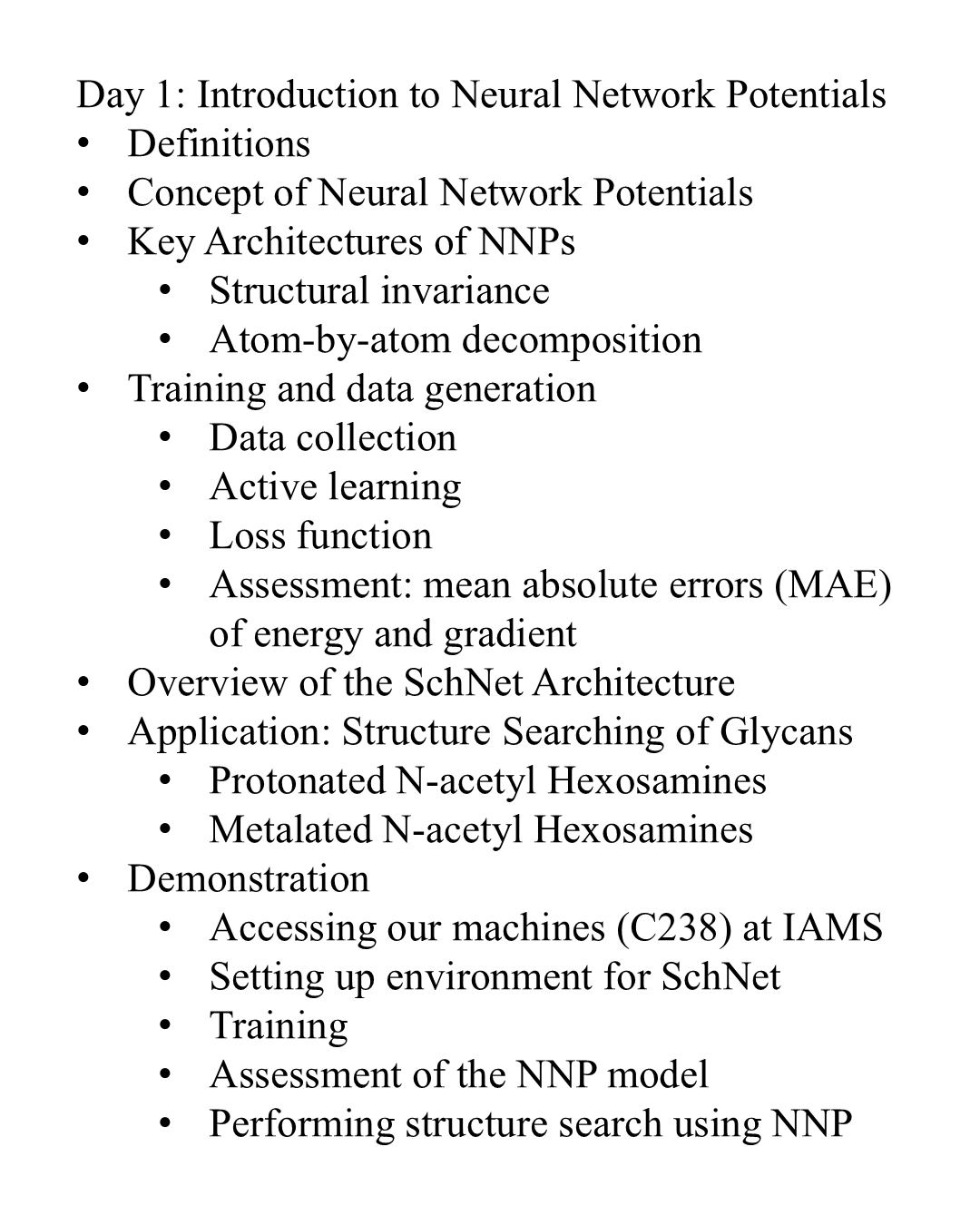
🌟 Day 1: Introduction to Neural Network Potentials
* Fundamentals of Neural Network Potentials
* Key NNP architectures
* Structural invariance and atom-wise decomposition
* Training workflows and data generation
* Active learning strategies
* Model assessment and error metrics
* Introduction to SchNet
* Demonstration of SchNet training and structure searching
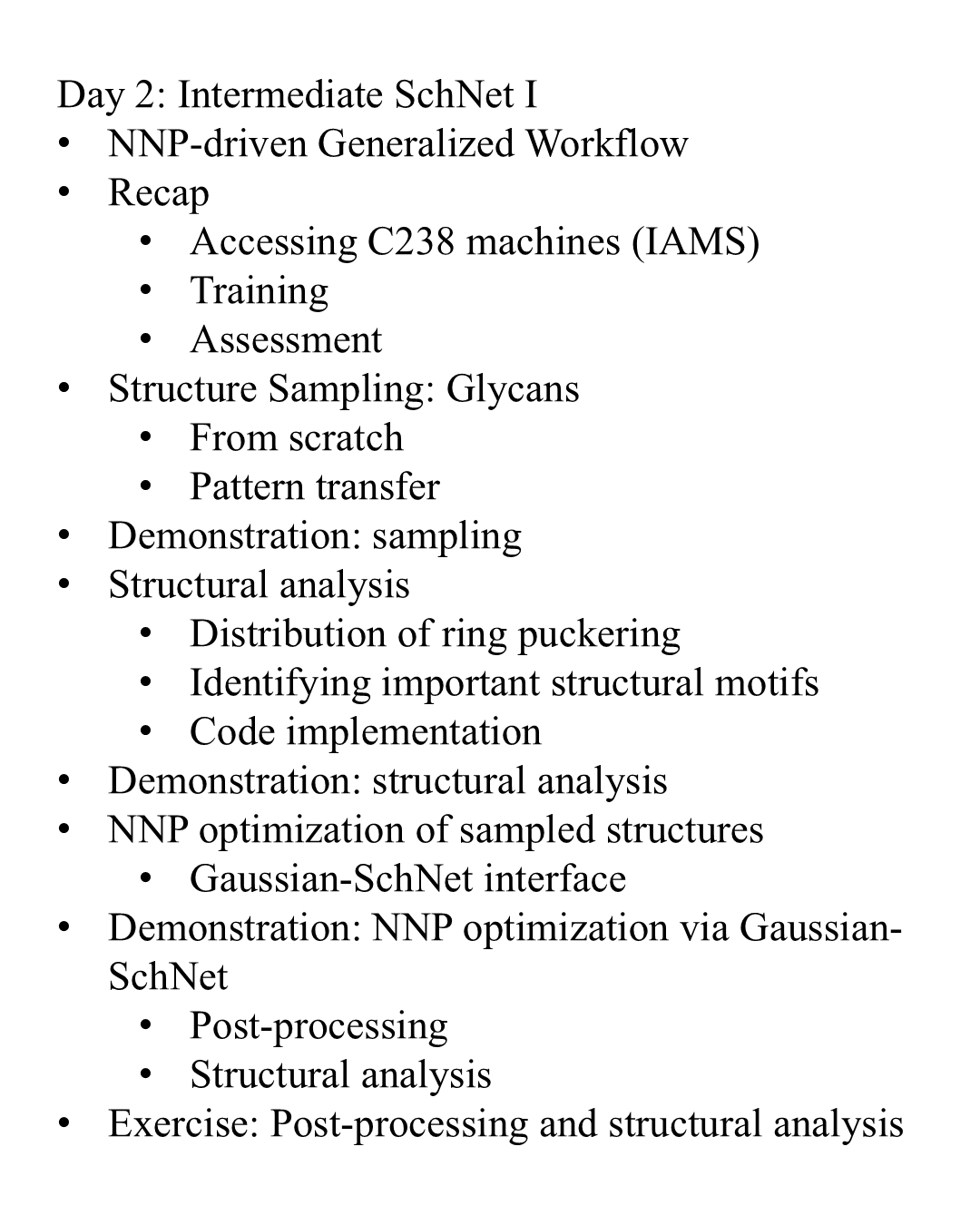
🌟 Day 2: Intermediate SchNet I
* NNP-driven molecular structure sampling
* Pattern-transfer workflows
* Structural analysis techniques
* Ring puckering distributions
* Structural motif identification
* NNP optimization workflows
* Gaussian–SchNet integration
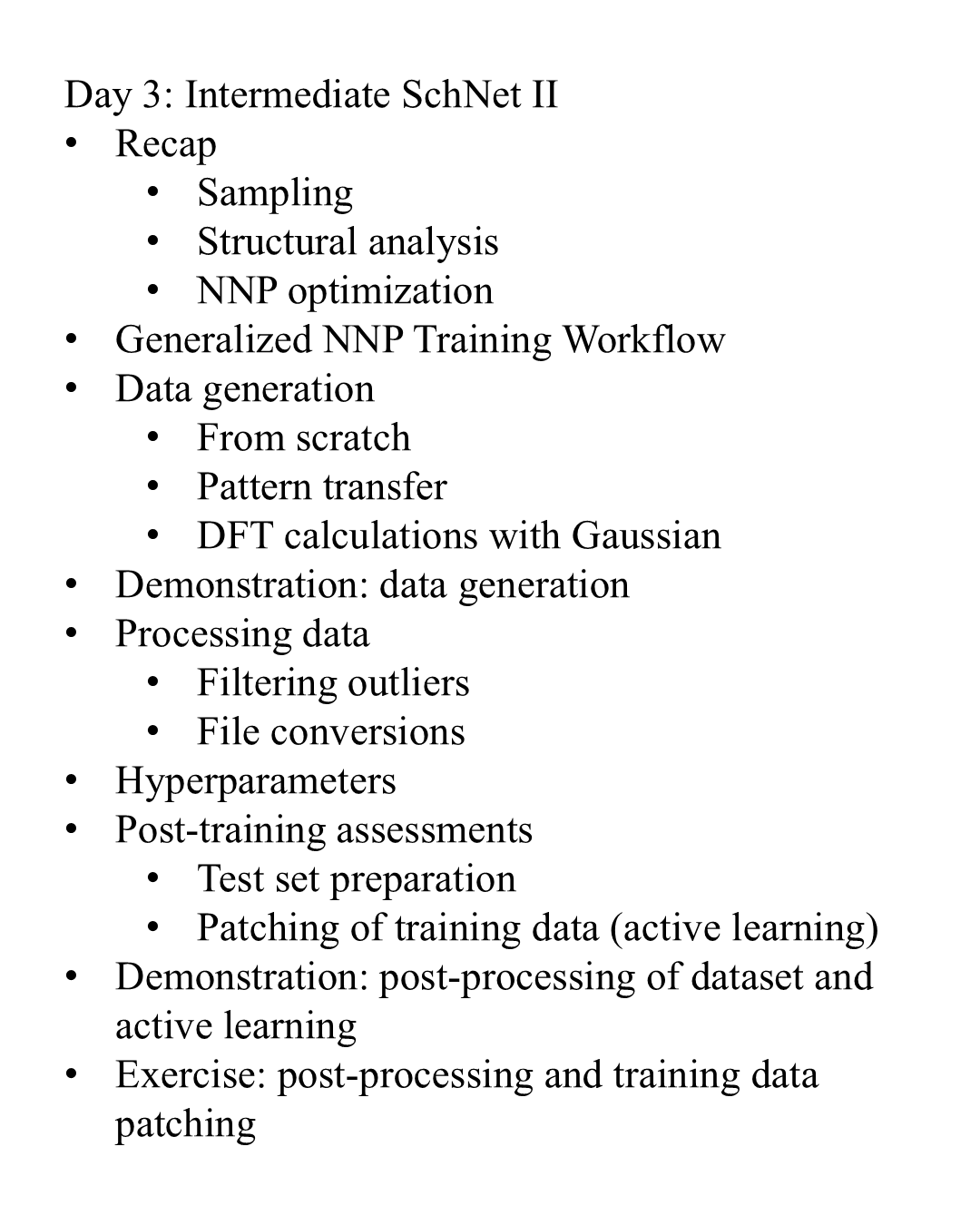
🌟 Day 3: Intermediate SchNet II
* Dataset generation and preparation
* DFT calculations with Gaussian
* Outlier detection and filtering
* Data processing workflows
* Hyperparameter considerations
* Active learning and dataset patching
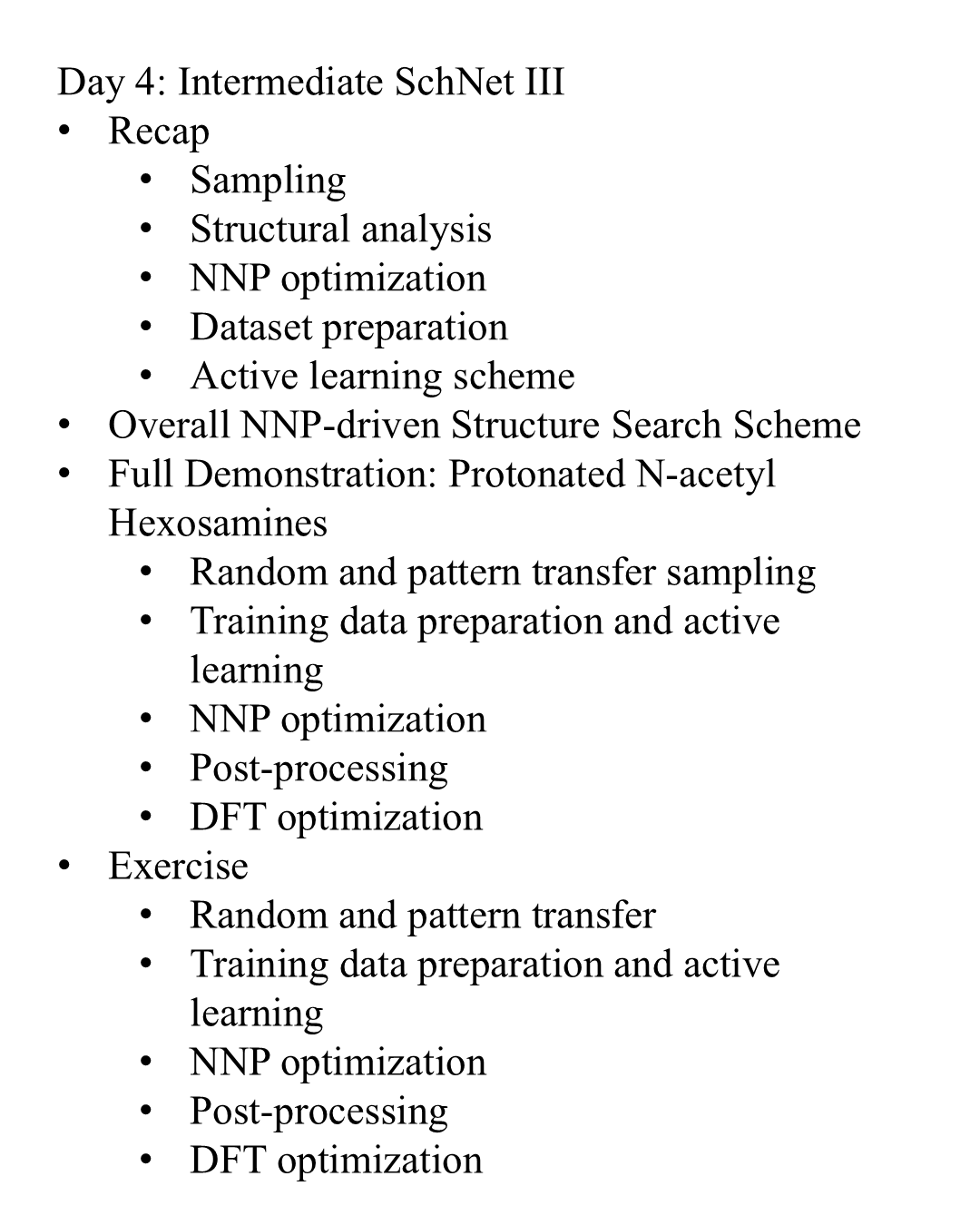
🌟 Day 4: Intermediate SchNet III
* Complete NNP-driven structure search workflows
* Training data preparation
* Active learning implementation
* NNP optimization
* DFT refinement and validation
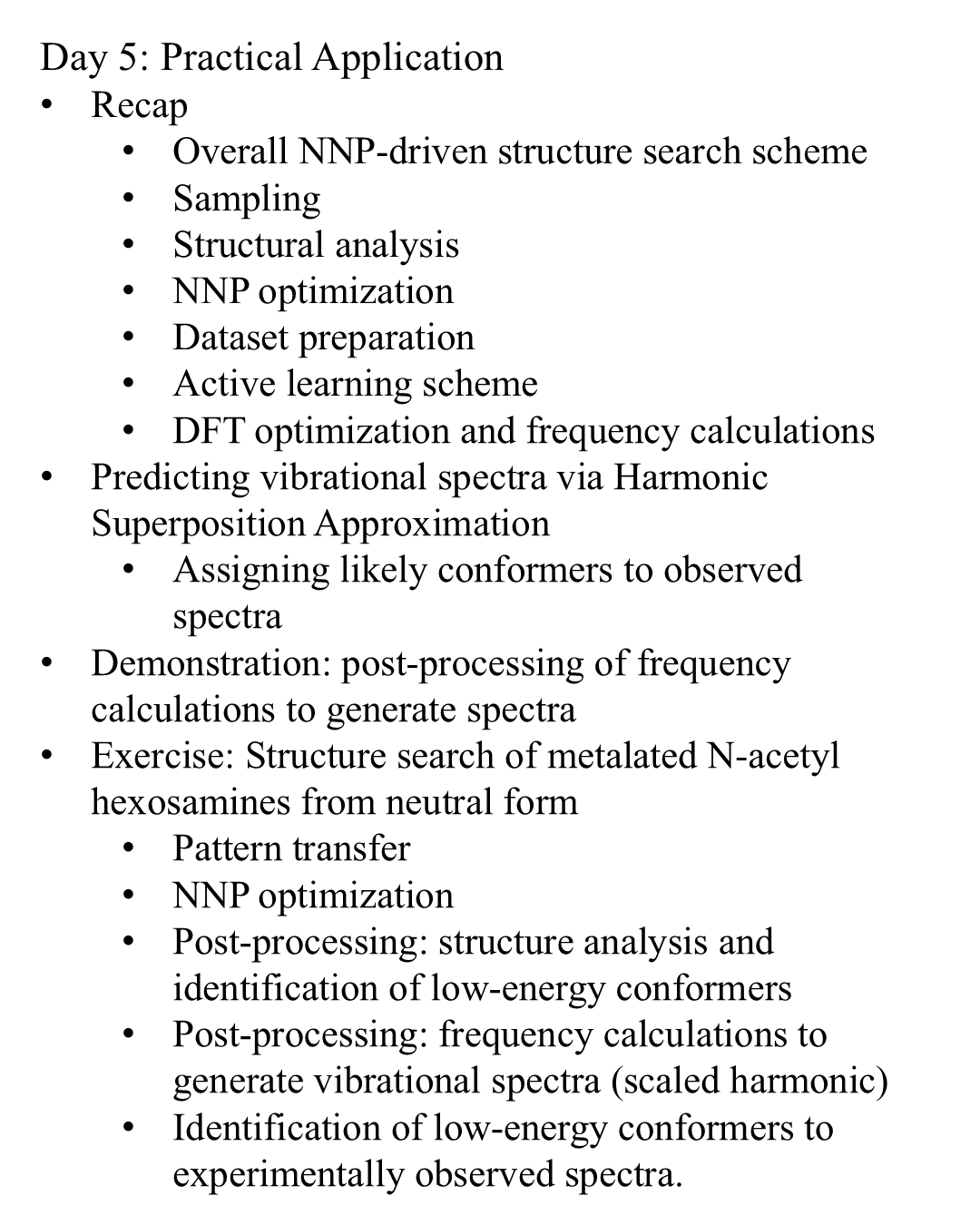
🌟 Day 5: Practical Applications and Mini Symposium
* End-to-end structure search workflows
* Frequency calculations and vibrational spectroscopy
* Harmonic Superposition Approximation
* Spectral assignment and conformer identification
* Case studies and practical exercises
* Mini Symposium and networking session
—
📅 Schedule
### Online Sessions, every Saturday, 9:00-12:00 Indochina Time (ICT)
* 20 June 2026
* 27 June 2026
* 4 July 2026
* 11 July 2026
### Hybrid Session + Mini Symposium, 9:00-16:00 Indochina Time (ICT)
* 21 July 2026
—
💰 Registration Fees
### KMUTT Students
2,900 THB
### Early Bird Registration
3,900 THB
**Extended until 12 June 2026**
### Regular Registration
4,500 THB
—
## Prerequisites
Participants are recommended to have:
* Basic Python programming skills
* Familiarity with Linux command-line environments
* Introductory knowledge of computational chemistry, materials science, physics, chemistry, engineering, or related fields
Prior experience with Neural Network Potentials, SchNet, or machine learning is not required.
—
## Certificate
Participants who attend at least 80% of the workshop sessions will receive an official Certificate of Completion issued by the Faculty of Science, KMUTT.
—
## Target Audience
* Graduate Students
* Researchers
* Faculty Members
* Industry Professionals
* Computational Chemists
* Materials Scientists
* Physicists
* Data Scientists
* AI Researchers
—
## Registration
Seats are limited to 40 participants to ensure an interactive learning environment and personalized guidance during hands-on sessions.
Register early to secure your place.
📍 Organized by
Nanoscience and Nanotechnology Program
Faculty of Science, KMUTT
📩 Registration & Contact
https://docs.google.com/forms/d/e/1FAIpQLSdOTc2zcV-4hCfUMmXMFInqihuEWLZ7VxrJ9HSuLL10wDD6jg/viewform?usp=header
 For more information